A Possible Becoming.
A Markham conversation about experience, interpretation, and discovery.
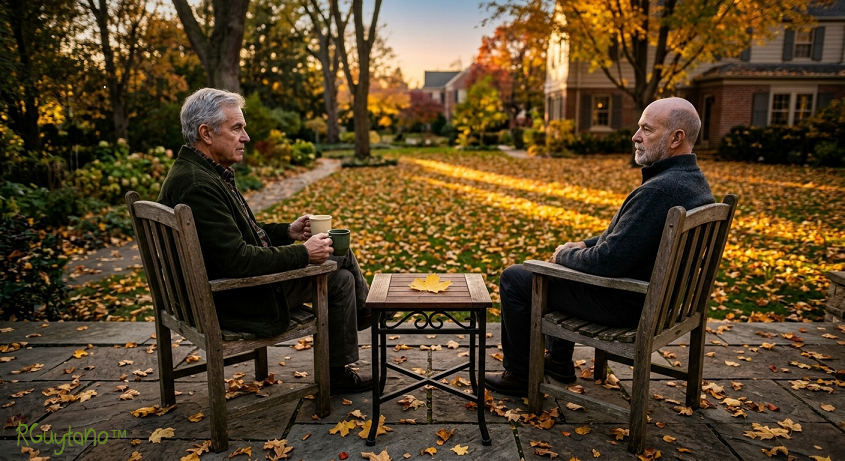
The afternoon had arrived without announcing itself.
Sunlight lay across the lawn in long, amber bands, illuminating the last of the summer grass beneath a scattering of fallen leaves. A breeze moved through the trees with just enough insistence to remind anyone sitting outdoors that October had nearly finished its work.
Markham occupied one of two wooden chairs on the terrace. I sat opposite, holding a cup of coffee between both hands.
From somewhere beyond the neighboring houses came the distant sound of a crowd cheering.
"Football," I observed.
"Apparently."
"Someone must have scored."
"Or failed to."
"Does it matter?"
"Very much to whoever is cheering."
I smiled.
"And very little to us."
Markham watched a yellow leaf separate from its branch, turn twice in the sunlight, and settle upon the grass.
"That," he said, "is rather interesting."
"The football?"
"The leaf."
I followed his gaze.
"What about it?"
"We both saw it fall."
"Yes."
"And yet I suspect we did not have the same experience."
"Why?"
"Because you were thinking about football."
"I was not."
"You mentioned it."
"That hardly establishes what I was thinking."
"No," Markham conceded. "It doesn't."
I took a sip of my coffee.
"You've begun rather badly."
"I've begun with an assumption."
"Which you mistook for knowledge."
"Precisely."
We sat quietly for a moment.
"There's a philosopher," I said, "who might have enjoyed that little exchange."
"Only one?"
"Bertrand Russell."
"Ah."
"And another who might have objected to nearly everything about it."
"Hegel?"
"Naturally."
"Then we have the beginnings of a respectable afternoon."
"Provided neither of them insists upon joining us."
Markham glanced at the empty chair beside the terrace door.
"We could accommodate one."
"Not both?"
"I should like to finish my coffee before sunset."
"I've been reading Russell," I began.
"A dangerous occupation."
"He wrote about mysticism and logic."
"An even more dangerous occupation."
"And I find myself wondering whether the distinction between them is as fundamental as he suggests."
"How do you understand it?"
"Mysticism seems to rely upon intuition, upon a kind of immediate knowing. Logic relies upon analysis, upon reasoning from one proposition to another."
"That sounds reasonable."
"But both begin with experience, don't they?"
Markham considered the question.
"Perhaps we should be careful with the word begin."
"Why?"
"Because we might mean two different things. We might mean that our inquiry begins with experience. Or we might mean that experience exists before thought, independently of it."
"Are those not the same?"
"I don't think we've established that."
I looked toward the trees.
"Then let us begin with something simple."
"A welcome development."
"The breeze."
"What about it?"
"I feel it upon my face."
"As do I."
"That is experience."
"Yes."
"Before I call it a breeze, before I explain atmospheric pressure or the movement of air, something is happening."
Markham nodded.
"Something is happening."
"And afterward, mind begins its work."
"Naming?"
"Naming. Comparing. Remembering other autumn afternoons. Deciding whether I am cold. Wondering whether I should fetch a sweater."
"All useful activities."
"Certainly. But they are not the breeze."
"No."
"They are accounts of the breeze."
"Some of them."
I frowned.
"Some?"
"The decision to fetch a sweater is more than an account. It is a response. And the response changes what action might occur next."
"So?"
"So perhaps we should not imagine experience and mind as two objects lying side by side, one waiting patiently for the other to arrive."
I looked down at my cup.
"You are complicating something that seemed perfectly straightforward."
"That is sometimes what philosophy is for."
"And sometimes what it ought to apologize for."
Markham laughed.
"Agreed."
"Let us return to Russell," I said.
"Must we?"
"He would insist that a mystical experience cannot establish the truth of a mystical conclusion."
"Quite right."
"Even if the person having the experience is utterly certain?"
"Especially then, perhaps."
"Why especially?"
"Because certainty is itself something we may experience. It tells us something about the condition of the person who is certain. It does not necessarily tell us whether the belief is true."
I thought about that.
"Suppose," Markham continued, "that someone sits beneath these trees and experiences an overwhelming sense of unity with everything around them."
"A mystical experience."
"Perhaps. They feel no separation between themselves and the world. No boundary. No distinction."
"And Russell would object?"
"Not to the experience. He would object if they concluded, solely from having felt that unity, that all things are therefore one in some ultimate metaphysical sense."
"Because they have moved from experience to interpretation."
"Yes."
"But isn't the scientist doing the same thing?"
"In what way?"
"The scientist observes something and constructs an explanation. That explanation is not the observation itself."
"Correct."
"Then both are interpreting experience."
"They are."
"And neither can claim to have escaped interpretation."
"Not merely by adopting the language of science or mysticism."
I leaned forward, thinking I might have him.
"Then what distinguishes them?"
"The manner in which their claims are examined," Markham said.
"A scientist may propose that the color of this afternoon's sky is explained by the scattering of sunlight through the atmosphere. The explanation can be tested, compared with other observations, revised, perhaps rejected."
"And the mystic?"
"The mystic may propose that the sense of unity reveals the ultimate nature of existence. But the intensity of that experience, however genuine, does not by itself provide a way for others to determine whether the proposition is true."
"So Russell gives science the advantage."
"An advantage in establishing publicly testable claims."
"Not necessarily in having a richer experience?"
"Certainly not."
"Or in discovering which questions are worth asking?"
"Not necessarily there either."
I smiled.
"Then mysticism might discover a possibility, while logic helps determine whether the possibility is coherent."
"Sometimes."
"And science might help determine whether it is true."
"When the claim is one that scientific investigation can address."
"Which leaves some questions unanswered."
"Indeed."
"Does that trouble you?"
"Less than an answer that has not been earned."
A gust of wind sent several leaves skittering across the terrace.
One caught against the leg of Markham's chair.
I watched him retrieve it.
"Now Hegel," he said.
"Must we invite him after all?"
"He would say you have not gone far enough."
"He usually does."
"You have placed experience on one side and interpretation on the other. Then you have suggested that neither mysticism nor logic can establish the ultimate nature of the encounter."
"Yes."
"But Hegel would object that the distinction itself is something consciousness produces."
"A formidable objection."
"He might say there is no pure experience waiting beneath our interpretations. Even to recognize something as immediate is already to have understood it in relation to something else."
Markham turned the leaf between his fingers.
"And what do you think?"
"I think he has found a weakness."
"In what?"
"In the idea that experience comes first."
"Perhaps."
"Only perhaps?"
"It depends upon what we mean."
I sighed.
"You are going to distinguish two meanings again."
"At least two."
"Very well."
"When I say experience comes first, I may be making a claim about the structure of reality. I may be saying that experience exists independently of mind, and that thought arrives afterward."
"And Hegel would challenge that."
"With considerable enthusiasm."
"But what is the other meaning?"
"That experience is where our inquiry begins."
I considered this.
"Not necessarily where existence begins."
"Exactly."
"So we need not establish that experience is metaphysically prior to thought in order to recognize that we encounter the world before we have finished explaining it."
Markham smiled.
"That is rather well put."
"But Hegel would still say the encounter is mediated."
"He might."
"And you?"
"I would ask what follows from that."
"Surely it follows that there is no experience untouched by mind."
"Does it?"
I paused.
"Doesn't it?"
"Suppose every account we give of experience employs concepts. Does that establish that experience itself cannot occur without those concepts?"
"Not necessarily."
"Then we must distinguish the conditions under which we describe experience from the conditions under which experience occurs."
I sat back, pleased with the distinction.
"Russell would approve of that distinction."
"I should hope so."
"Hegel might not."
"Then the afternoon remains interesting."
The distant crowd erupted again.
This time the cheering continued long enough to be unmistakable.
"Someone has scored," I announced abruptly.
"Or the referee has made a spectacularly unpopular decision."
"You refuse to allow me a single certainty."
"On the contrary. I am quite certain someone is making a great deal of noise."
I laughed.
"And Werner Erhard?"
Markham raised an eyebrow.
"Now we are inviting everyone."
"He might ask why we're spending this beautiful afternoon arguing about the nature of experience instead of simply enjoying it."
"Would he?"
"Perhaps not in those words. But he might ask what becomes possible when we stop insisting upon an explanation."
"An excellent question."
"And?"
"And what?"
"What becomes possible?"
Markham looked around the terrace.
"The afternoon, perhaps."
I followed his gaze.
"The afternoon was already here."
"Was it?"
"Of course."
"Then why did we need to stop arguing in order to notice it?"
We sat quietly.
The air had cooled. Sunlight had moved from the lawn to the upper branches of the trees. Somewhere nearby, a bird gave a brief, uncertain call.
I set down my cup.
"I see what you mean."
"Do you?"
"I think so. We can become so occupied with our explanations that we cease attending to what is happening."
"Yes."
"But that does not make explanation wrong."
"Certainly not."
"It merely means explanation is not the whole of living."
Markham nodded.
"Nor is the absence of explanation."
"What do you mean?"
"A person may refuse every interpretation, every judgment, every conclusion, and still remain profoundly confused."
"Then Erhard's invitation to be with what is does not settle the philosophical question."
"No."
"But it may change our relationship to the question."
"Precisely."
I considered this.
"Hegel wants us to complete the inquiry."
"Perhaps."
"Russell wants us to justify our conclusions."
"Yes."
"Erhard wants us to notice what becomes possible when we stop being governed by them."
"A useful way of distinguishing their emphases."
"And you?"
Markham smiled.
"I should like another cup of coffee."
I did not move.
"You are avoiding the question."
"Am I?"
"Yes."
"Then perhaps I should answer it."
"Please."
Markham placed the leaf upon the small table between us.
"I wonder whether we have been making a mistake from the beginning."
"Which mistake?"
"We have been speaking as though the purpose of inquiry were to arrive at a position from which the world could finally be understood."
"Isn't it?"
"Sometimes."
"But not always?"
"Consider what we are doing now."
"Talking."
"About?"
"Experience. Interpretation. Knowledge."
"And what has happened during our conversation?"
I glanced toward the trees.
"The afternoon has passed."
"That is an account of what has happened."
"An accurate one."
"But is it all that has happened?"
I thought about that for a moment.
"I have changed my mind about certain things."
"Then something more than description has occurred."
"Learning?"
"Perhaps."
"Discovery?"
"Certainly."
"And you think discovery changes the encounter?"
"I think it may change the way we participate in it."
I leaned back in my chair.
"Then we are not spectators."
"No."
"We are part of what we are trying to understand."
"Yes."
"Which means our inquiry is itself an event within the world."
Markham nodded.
"And therefore?"
I hesitated.
"Therefore, a complete account of the world would have to include the act of making the account."
"An interesting difficulty."
"And the person making it."
"Another."
"And the way the account changes that person's subsequent experience."
"Another still."
I looked at him, considering.
"Doesn't that make complete understanding impossible?"
"I don't know."
"But surely it makes it difficult."
"Undoubtedly."
"Then perhaps Hegel is wrong."
"Perhaps. But we have not disproved him by discovering that his ambition is difficult."
"And Russell?"
"We have not disproved him by discovering that some experiences resist public verification."
"Erhard?"
"We have not disproved him by discovering that transformation is not the same as explanation."
I shook my head.
"You have managed to avoid declaring any of them wrong."
"Not intentionally."
"Or right."
"That would require rather more work."
"And where does that leave us?"
Markham looked toward the last sunlight on the lawn.
"Here."
For several minutes, neither of us spoke.
A squirrel appeared at the edge of the terrace, regarded us with apparent suspicion, and hurried away.
I laughed softly.
"What?"
"The squirrel."
"What about it?"
"It looked as though it disapproved of us."
"An interpretation."
"Of course."
"Not an unreasonable one."
We both laughed at that.
Then I became thoughtful.
"Something is bothering me."
"Tell me."
"We have been distinguishing experience from interpretation. But every time we try to describe experience, we interpret it."
"Yes."
"Then how can we ever know that we have reached experience itself?"
Markham considered the question for a long moment.
"Perhaps we cannot know that in the way you mean."
"Then the distinction collapses."
"Does it?"
"If we cannot identify experience without interpreting it, how can we distinguish the two?"
Markham picked up the leaf.
"Look at this."
I looked.
"What do you see?"
"A leaf."
"Anything else?"
"Yellow, mostly. Brown along the edges. A small tear near the stem."
"Good."
"And?"
"Now suppose I tell you that this leaf reminds me of my childhood."
"Does it?"
"No. But suppose it did."
"Very well."
"And suppose I tell you that autumn is melancholy because everything beautiful is dying."
"That would be an interpretation."
"Yes."
"But the leaf is still yellow."
"As far as we can presently determine."
"And the tear is still there."
"Yes."
"So?"
"So perhaps the distinction does not require us to separate experience from interpretation as though we could place them in different rooms."
I waited, curious to find out where he was headed.
"Perhaps it requires us to recognize that we are doing different things when we notice the color of a leaf, remember a childhood afternoon, and declare that autumn is melancholy."
"Even though all three may occur together."
"Especially then."
I looked again at the leaf.
"And if I say autumn is beautiful?"
"Another judgment."
"But one I enjoy."
"Then enjoy it."
"Without pretending I have established that autumn is beautiful for everyone."
"Precisely."
I smiled.
"That seems almost embarrassingly simple."
"Many useful distinctions are."
The sun had nearly disappeared behind the trees.
I stood and gathered the cups.
"One last question."
"Only one?"
"For now."
"Then I shall give it my full attention."
"If our interpretations shape the way we participate in the world, and our participation changes what happens next, doesn't that mean interpretation is itself part of experience?"
Markham looked up.
"Yes."
"Then experience produces interpretation, and interpretation becomes part of subsequent experience."
"It would seem so."
"And that subsequent experience produces further interpretation."
"Quite possibly."
"Then we have a circle."
"Or a movement."
"Which?"
"I don't know."
I remained standing.
"Perhaps that is what Hegel was trying to tell us."
"Perhaps."
"Or perhaps Erhard would say we've finally noticed how our distinctions shape what becomes possible."
"Perhaps."
"And Russell?"
"He might ask whether we have sufficient evidence to justify either conclusion."
I laughed.
"And Markham?"
Markham rose from his chair.
"Markham might ask whether something has happened here that none of those descriptions quite captures."
I looked around the terrace.
"What?"
"The conversation."
"But surely the conversation can be described."
"Of course."
"Then what is missing?"
Markham considered the question.
"The fact that neither of us knew what the other would say."
I paused.
"That's true."
"And neither of us knew what we ourselves would think after hearing it."
"No."
"Yet here we are."
I looked at the two empty chairs, the cups, the leaf upon the table.
"Are you suggesting that the conversation has produced something neither of us possessed before it began?"
"I am wondering."
"A new understanding?"
"Perhaps."
"A new interpretation?"
"Certainly."
"Then we're back where we started."
"Are we?"
I looked once more toward the trees.
The last light had gone from their upper branches. A few leaves continued to drift through the cooling air.
"No," I said at last. "I suppose we're not."
Markham waited.
"When we began, I wanted to know which was more trustworthy. Mysticism or logic."
"And now?"
"Now I'm wondering whether the question itself was too small."
"How so?"
"Because neither intuition nor analysis happens in isolation. Both occur within a life. Within an encounter. Within a world in which we are participating."
Markham nodded.
"And?"
"And perhaps the most important thing about our conversation isn't which interpretation prevailed."
"What is it, then?"
I looked at him.
"That something became available to us which wasn't available before."
Markham smiled.
"That is worth considering."
I carried the cups inside.
At the doorway, I stopped.
"Markham?"
"Yes?"
"There's something rather curious about all this."
"What?"
"We've spent the afternoon examining whether experience can be separated from interpretation."
"We have."
"And now, when I think about this afternoon, I shall remember the conversation."
"Naturally."
"But I shall also remember the light. The leaves. The coffee. That ridiculous squirrel."
"Who may well remember us with equal disapproval."
"And I cannot quite tell which part of the afternoon was experience and which was interpretation."
"Perhaps you needn't."
"Why not?"
"Because distinguishing them need not mean tearing them apart."
I looked back toward the terrace.
The leaf remained upon the table, where Markham had placed it.
"Then what does the distinction accomplish?"
Markham followed my gaze.
"Perhaps it gives us the freedom to notice when we have begun treating one as the other."
"And then?"
"Then we may choose what to do with that recognition."
I considered this.
"Choose?"
"Sometimes."
"Doesn't that make freedom another interpretation?"
"It may."
"And how would we establish whether it is real?"
"A question for another afternoon."
I laughed.
"Convenient."
"Very."
We stepped inside.
From the neighboring house came another eruption of cheering, followed by a man's anguished shout.
I stopped.
"Well, that settles it."
"What?"
"Someone has definitely scored."
Markham listened.
"Or failed to."
"Markham!"
He laughed.
And as I turned toward the kitchen, Markham glanced once more through the open doorway.
The leaf was still there.
His hand moved toward it, then stopped.
He left it where it lay.
I found myself wondering whether the most interesting thing about the leaf was not what either of us had made of it, but that it had entered our conversation without asking permission.
And whether the same might be true of almost everything worth discovering.
Read the original & join the discussion on Substack ↗
Continue the conversation.
What has a conversation made possible for you that wasn’t available before?
Email a response to this dialogue ↗Private correspondence. Nothing is published without your permission. How the guestbook works.