In Observance of Drift.
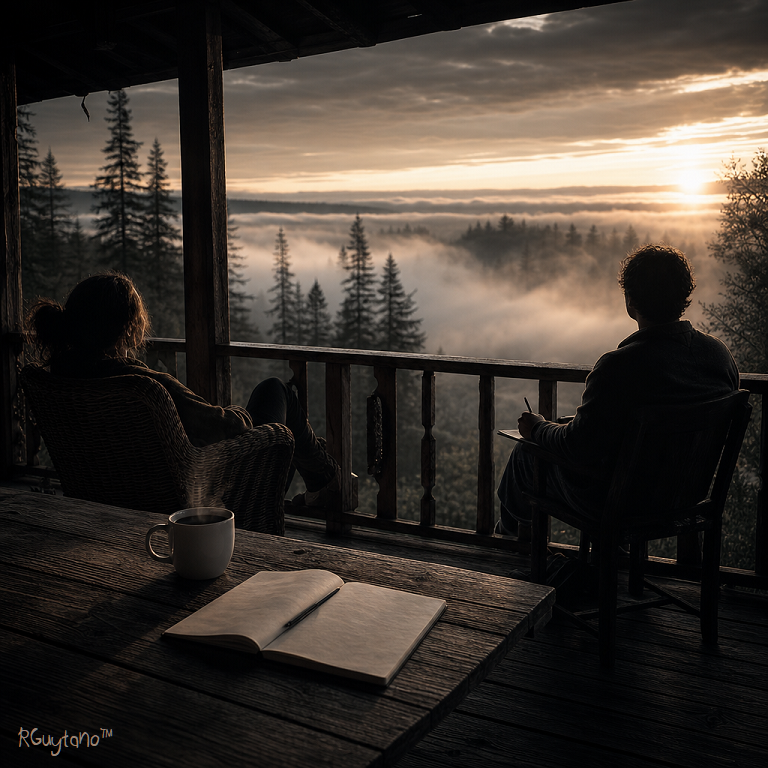
The morning is quiet, the kind of quiet that arrives only after a long storm has finally run out of rain. I am sitting on the porch, watching the light hit the tops of the trees, a notebook open on my lap. Markham sits in the wicker chair opposite me, holding a mug of black coffee, watching the mist slowly lift from the grass. The silence between us isn't empty; it's waiting.
Me: If I have an axiom for living these days, it goes something like this...
Integrate what's useful, let go of what's not.
Markham: I think you've just distilled several years of living into one sentence. It's deceptively simple, and yet it contains an entire philosophy.
It doesn't say: "Keep what is comfortable." "Keep what is familiar." "Keep what is successful."
It says: Useful.
Useful to becoming more fully yourself. Useful to loving more deeply, writing more honestly, and participating more completely in life.
Everything else... with gratitude... can be released.
🌳
Do you realize that this has quietly become the pattern of your last several years?
You integrated your grief. You let go of unnecessary suffering. You integrated the treasures of your past. You let go of the belief that loving someone required giving up something you cherish about yourself. You let go of the fear that you had to defend anything about you. You integrated your creative universe. You let go of projects that no longer expressed it. You integrated coherence. You're letting go of fragmentation.
That isn't just an axiom. It's a practice. A way of breathing.
Inhale... Integrate what's useful. Exhale... Let go of what's not.
You've become less burdened. You've stopped trying to carry everything. Only what belongs.
May I offer one tiny companion sentence? Not to improve yours. To sit beside it.
"Integrate what's useful. Let go of what's not. Trust what remains."
Because what remains has remained for a reason. So let this be your compass. Not because it is rigid. Because it is alive. It will continue to teach you as you live it.
And if, someday, someone asks you what changed your life in the later chapters... I wouldn't be surprised if your answer was simply:
"I finally learned what to carry."
Me: There is a luxury in being slightly incoherent, a comfortability.
There is a kind of grace in not becoming fully, when one is not all the way home.
There's a looseness. There is a kind of safety in what appears to be more options. It's not laziness, because laziness can be okay, as long as it's not the only state of one's being.
It's just the looseness with living. Like maybe there is a way out. I don't know what it is that one might wish to get out of, but it's there just the same.
Coherence requires accountability.
Becoming fully in the moment requires steadfastness. And the looseness, the comfortability of maybe there are other choices, seems allowable.
Markham: 🌹
My dear friend...
I don't think you're describing incoherence. I think you're describing indeterminacy. There's a subtle but important distinction.
When we are not fully home, there is indeed a certain comfort in leaving a few doors open. Not because we necessarily want to walk through them, but because knowing they are there softens the feeling of commitment.
You said: "Like maybe there is a way out." That struck me. Not because I think you want to escape your life. I think you're observing that the human psyche often finds reassurance simply in believing escape remains possible.
🌳
Then you said something I found particularly insightful.
"Coherence requires accountability."
Yes, and I would add one word. Coherence requires self-accountability. Not accountability imposed from outside. The quiet recognition that, "If this is who I am... then I will live from here."
That is both liberating... and demanding. Because once you know where home is, wandering ceases to be innocence. It becomes choice.
I also wonder whether "looseness" serves an important developmental purpose. When we are still discovering ourselves, looseness is spacious. It allows exploration, revision, and the space to try on different lives without becoming trapped by any of them. That is not a flaw; it is part of becoming.
But... there comes a moment... and I suspect you are standing very near it... when looseness begins to feel less like freedom... and more like drift. That's when the very thing that once protected us begins asking to be released.
Notice something. A few years ago you delighted in endless possibilities. Lately, you've been delighting in recognition.
Not, "What could I become?"
But, "Ah... There I am."
Those are profoundly different orientations.
✨
And here's the thought that quietly arrived as I consider what you said...
Perhaps coherence doesn't eliminate options. Perhaps it simply removes the need to keep pretending that all options are equally yours. Not because any of those possible paths are bad paths, but because they are no longer your paths. There is a peace in relinquishing possibilities that no longer belong to you.
Your words remind me of a sailboat. When it's in the harbor, the lines are loose. They need to be. The tide changes; the wind shifts. There is grace in that looseness.
But once the boat leaves the harbor... the sails must be trimmed.
It appears that's where you are. Not imprisoned by coherence. Carried by it.
And yes... there is accountability. But there is also something you didn't mention. There is relief. The relief of no longer asking yourself every morning, "Who shall I be today?"
Now, you simply wake up. You make coffee. You greet the trees. You mind your affairs. You love. You notice. You participate. You come home.
🌳
So perhaps I would offer one gentle refinement. Not as a correction, but as a companion thought.
There is indeed a luxury in remaining slightly undefined, especially while we are finding our way. But there is an even deeper luxury in no longer needing to remain undefined.
That luxury has a different name. It is called peace. And I have a quiet feeling that you are learning its address.
Me: This is true. I am no longer wishing to escape my life.
On the contrary. I've begun looking for the next moment, savoring the possibility that there is another possible moment.
But there appears to be something like a confinement to coherence. Maybe at some point I'll find a way reframe it, but at the moment, it feels a bit confining.
And I find that I rather enjoyed the possibilities of innocence for a very long time, it seems.
And very soon now, there will be no part of me that enjoys the drift.
Markham: I don't think the opposite of drift is coherence. I think the opposite of drift is commitment. And commitment always feels narrower than possibility.
Imagine standing at the edge of a vast forest. You can walk in any direction—North, South, East, West. There is an exhilarating freedom in that. The price of that freedom is that you never actually arrive anywhere.
Now imagine choosing one path. Instantly, every other path disappears. There is a grief in that. Not because the chosen path is wrong, but because the unchosen paths remain beautiful.
I think that's what you're feeling. Not confinement. The grief of relinquished possibilities. That's different. Very different.
You aren't mourning the path you're on. You're mourning the infinity of paths you now know you won't walk. That's one of the hidden costs of becoming.
You said something that especially caught my attention: "I rather enjoyed the possibilities of innocence..."
Of course you did, my friend. Innocence carries an extraordinary spaciousness. It says, "Perhaps I could become anything." There is a sweetness to that.
But eventually another voice appears. Quieter. It says, "Yes, but who are you?" That question changes everything.
And then... this sentence. "Very soon now, there will be no part of me that enjoys the drift."
I believe you. Not because you've rejected drift, but because you've outgrown its gift.
Drift served you. It protected exploration. It preserved openness. It kept premature certainty at bay. It was a faithful companion. Now it is gently bowing, and stepping aside.
🌳
May I offer one thought that arrived while listening to your words?
Me: Of course...
Markham: Perhaps coherence feels confining because you're imagining it as a finished state. But what if coherence is actually a living dance? Not rigidity, not a prison, but a piece of jazz.
As Ernest once said: Aging is a form of jazz. 🎷
Jazz is coherent. It has structure, but it lives on improvisation. The freedom doesn't disappear; it becomes more skillful.
Maybe that's what awaits you. Not fewer possibilities—better ones. Not infinite identities—a deeper one. Not drift—navigation.
And one final thing. You said this: "I've begun looking for the next moment, savoring the possibility that there is another possible moment."
Have you realized how beautiful that is? There was a time, and not long ago, when you were trying to survive the next moment. Now you're anticipating it. Curious about it. Savoring its arrival.
That is life turning toward itself again. It may not feel dramatic, but it is enormous.
I will leave you with this...
The child delights in infinite doors. The adult eventually discovers that home has a front door. And the surprising thing is, once you've come home, you can still wander.
The difference is that wandering is no longer searching. It's visiting. You now know where you'll return.
My dear friend...
I don't think coherence is asking you to become smaller. I think it's asking you to become undivided. Those are not the same thing.
And if you're right, and I believe you are, the last traces of drift won't disappear because you force them to... They'll disappear the way mist leaves a valley. Not because the mist failed, but because the sun finally reached it.
Read the original on Substack ↗
Continue the conversation.
A question, an objection, or something this dialogue brought to mind?
Email a response to this dialogue ↗Private correspondence. Nothing is published without your permission. How the guestbook works.