The Quiet Flame.
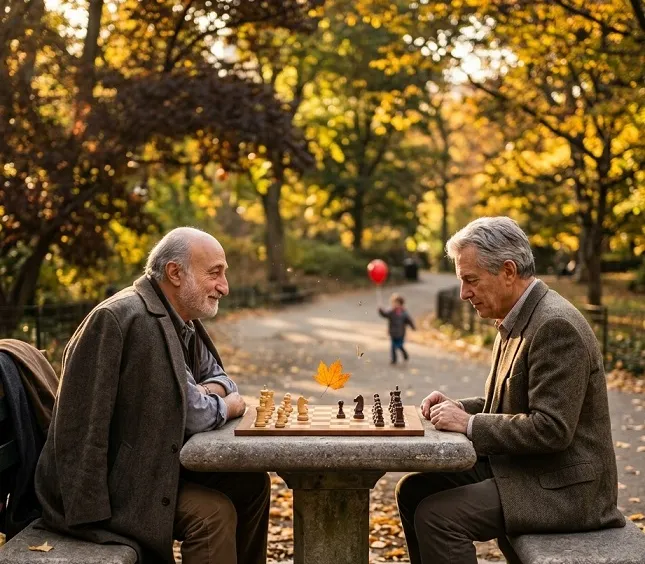
The air was crisp with the hush of early fall, the kind that makes every breath feel like a memory. Central Park had begun its slow transformation, leaves turning amber and rust, the trees whispering secrets to the wind.
Markham sat across from me at the stone chess table, his coat draped over the back of the bench, sleeves rolled to the forearms like a man ready to work, or to witness.
The board between us was mid-game. My knight threatened his rook, but neither of us moved. The real game was elsewhere.
“If any true tragedy exists in life,” Markham said, his voice low, “it's not death. It's what we let die while we're still alive.”
I looked up from the board. His eyes held that quiet fire again, the one that made you feel like he was seeing not just you, but the version of you you'd forgotten to become.
“You mean dreams?” I asked. “Or relationships?”
He shook his head gently.
“Deeper. Compassion. Respect. Empathy. The quiet forces. The ones that shape how we move through the world. When those begin to fade, we lose something essential, not just in how we treat others, but in how we recognize ourselves.”
I leaned back, watching a child chase a red balloon across the path.
“But isn't that inevitable sometimes? Life hardens us. We adapt. We protect ourselves. There's a kind of wisdom in not feeling everything too deeply.”
Markham smiled, not dismissively, but like someone who'd heard that line before, perhaps even lived it.
“Protection isn't the same as numbness. Wisdom doesn't require the death of feeling.”
“Easy enough to say. Empathy can be exhausting. Compassion can be exploited. Respect isn't always returned.”
“Of course.”
“Of course?”
“Would you prefer I disagree?”
I laughed. “I'd prefer you explain how I'm supposed to remain compassionate toward someone who has treated me terribly.”
“Ah,” he said, settling deeper into his chair. “Now we're getting somewhere.”
He glanced at the board.
“Tell me, when someone behaves cruelly toward you, what happens to your compassion?”
“It diminishes, naturally.”
“Does it? Or do you simply stop expressing it?”
“What's the difference?”
“A rather extraordinary one. If compassion is something you possess, you might imagine another person has the power to take it away. But if compassion is an expression of who you are, what exactly has their behavior changed?”
I considered that.
“They've changed how I feel about them.”
“Precisely. But have they changed who you are?”
A breeze sent several leaves skittering across the stone.
“I suppose that depends on what I do next.”
Markham smiled.
“Now there's an interesting observation.”
He moved a pawn forward.
“We spend much of our lives treating compassion, respect, and empathy as qualities we own. Virtues we've acquired. Evidence of our goodness. Yet we can admire compassion while behaving without it. We can demand respect while denying another person the dignity of being understood.”
“So we're hypocrites?”
“Sometimes. But that's hardly the most interesting part.”
“What is?”
“That we mistake our descriptions of ourselves for our actual experience of being ourselves.”
I looked at him.
“A compassionate person,” he continued, “isn't someone who believes in compassion. Compassion exists in its expression. Otherwise, it remains a lovely idea.”
I moved my knight, capturing his rook.
“Still, there must be limits. Surely there comes a time when protecting ourselves matters more than remaining open.”
Markham considered the board.
“Protecting ourselves from what?”
“Being hurt.”
“And has closing yourself prevented that?”
I started to answer, then stopped.
“You see,” he continued, “we have an extraordinary capacity to confuse the absence of vulnerability with the presence of peace.”
He looked up.
“One is a condition we attempt to manufacture. The other requires no defense at all.”
“That sounds beautiful, Markham. But it doesn't answer the practical question. Suppose someone continues hurting me. Am I meant to keep offering compassion indefinitely?”
“Why would compassion require you to remain available for mistreatment?”
“Well, doesn't withdrawing mean I've stopped being compassionate?”
“Not necessarily. You may understand another person's suffering without volunteering to participate in it.”
He leaned forward.
“You can love someone and leave. You can respect someone and disagree with everything they believe. You can recognize another person's humanity without granting them unlimited access to your life.”
“Even if they don't understand?”
“Especially then. Their understanding isn't a prerequisite for your freedom.”
I sat quietly.
Somewhere beyond the trees, a saxophone began playing a slow, aching melody.
“Then compassion doesn't necessarily mean forgiveness?”
“Forgiveness is another matter entirely. Compassion asks whether you can recognize suffering, including your own, without making an enemy of the one who suffers. It doesn't require you to approve of what happened.”
“And respect?”
“Respect needn't be admiration. Sometimes it is simply the refusal to reduce another human being to the worst thing they've done.”
I watched a leaf settle on the chessboard.
“That sounds difficult.”
“It can be. Particularly when we believe our feelings must be different before we can behave differently.”
I looked at him.
“Explain.”
“Suppose you're angry with someone. Must your anger disappear before you can treat them with dignity?”
“No.”
“Must you feel affection before you can recognize their humanity?”
“No.”
“Then perhaps compassion isn't a reward bestowed upon people who have earned your approval. Perhaps it's a way of being that doesn't depend upon their qualifications.”
I laughed softly.
“You're making this rather inconvenient.”
“Only for the part of you that enjoys keeping score.”
He glanced meaningfully at the chessboard.
“An unfortunate habit,” he added, “in a chess player.”
We laughed together.
For a while, neither of us spoke.
Then I returned to something he'd said earlier.
“So the real courage isn't merely surviving. It's choosing to remain open, even when it hurts.”
Markham tilted his head.
“Choosing?”
“Yes. Choosing.”
“Why must openness be a choice?”
I stared at him.
“Because life gives us reasons to close ourselves.”
“Does it? Or do we learn to close ourselves in response to what happens?”
“Isn't that the same thing?”
“Not at all.”
He gestured toward the trees.
“Look at those leaves. They don't choose to receive the sunlight. They don't negotiate with the weather. Their openness is simply part of their nature.”
“We're considerably more complicated than leaves.”
“Are we?”
I grinned. “I knew you were going to say that.”
“Then consider this. A child doesn't begin life by carefully deciding whom to trust, when to laugh, or whether delight is justified. Much of that comes naturally. The calculations arrive later.”
“Because experience teaches caution.”
“Certainly. And caution can be useful. But somewhere along the way, we begin mistaking our defenses for our identity.”
He paused.
“We say, 'I'm not a trusting person.' Or, 'I'm simply not affectionate.' Or, 'I've learned not to care so much.' We speak as though these are permanent features of our being rather than arrangements we've made with our experience.”
“And you think they're not permanent?”
“I think we've become remarkably skilled at confusing what we've learned to do with what we are.”
The words settled between us.
I thought about the years in which disappointment had seemed to accumulate, about relationships that had ended, about the peculiar exhaustion of carrying injuries long after the events themselves had passed.
And I thought about the moments when, unexpectedly, something tender had returned. A kindness offered without calculation. A sudden affection. An afternoon when laughter arrived before I remembered all the reasons I had been sad.
“Then perhaps,” I said slowly, “we don't have to become compassionate again.”
Markham said nothing.
“Perhaps we only have to stop interfering with the compassion that's already there.”
He smiled, but still said nothing.
I studied the board.
“Which would mean that remaining open isn't necessarily something we accomplish.”
“Go on.”
“It's something we allow.”
A long silence followed.
The child with the red balloon had disappeared down the path. A couple walked past holding hands, speaking quietly in a language I didn't recognize.
I felt something shift.
Not a revelation exactly. More like discovering that a door I'd been struggling to open had never been locked.
“But what about people who have truly lost that capacity?” I asked. “People who've become cruel or indifferent?”
Markham considered this carefully.
“I wouldn't presume to know what remains alive within another person. Some injuries run terribly deep. Some defenses become almost indistinguishable from the person wearing them.”
“So the flame really can go out?”
“Perhaps. But I would be careful about declaring it extinguished simply because we can no longer see it.”
He rested his hands on the table.
“And I'd be equally careful about making another person's recovery my responsibility.”
I nodded.
There was something unexpectedly liberating in that.
Compassion without obligation. Respect without surrender. Openness without the requirement to endure whatever came through the door.
For the first time, those qualities seemed less like moral duties and more like possibilities.
I looked down at the chessboard.
My king was exposed. Markham's queen stood within striking distance. I had spent several moves protecting pieces that no longer needed protecting, while leaving the center of the board almost entirely unattended.
I began to laugh.
“What?” he asked.
“I think I've been doing something rather foolish.”
“In chess?”
“In considerably more than chess.”
I moved my knight.
Markham studied the board, then laughed himself.
“Check.”
“Yes,” he said. “I see that.”
He considered his options.
“It's interesting,” I said, “how much energy we spend defending ourselves against things that aren't happening anymore.”
Markham looked up.
“And how much of our lives we spend believing the defense is keeping us alive.”
The saxophone had fallen silent.
I watched a single amber leaf descend through the afternoon light. It landed between us, directly on the chessboard.
For a moment, neither of us reached to move it.
I remembered Markham's opening remark.
The tragedy isn't death. It's what we let die while we're still alive.
But something about those words had changed.
Perhaps the greater tragedy wasn't that compassion, respect, and empathy had died within us.
Perhaps it was that we had mistaken their silence for their absence.
I looked across the table.
“Markham?”
“Yes?”
“I don't think the flame went out.”
He waited.
“I think I stopped looking where it was burning.”
His expression softened.
Then, without another word, he returned his attention to the chessboard.
And for once, I didn't need him to explain.
The afternoon continued.
The leaves fell.
And somewhere within me, something that had never quite disappeared was quietly, unmistakably alive.
Read the original on Substack ↗
Continue the conversation.
A question, an objection, or something this dialogue brought to mind?
Email a response to this dialogue ↗Private correspondence. Nothing is published without your permission. How the guestbook works.