The Work of an Afternoon.
Being, wanting, and the work of a fall Sunday afternoon.
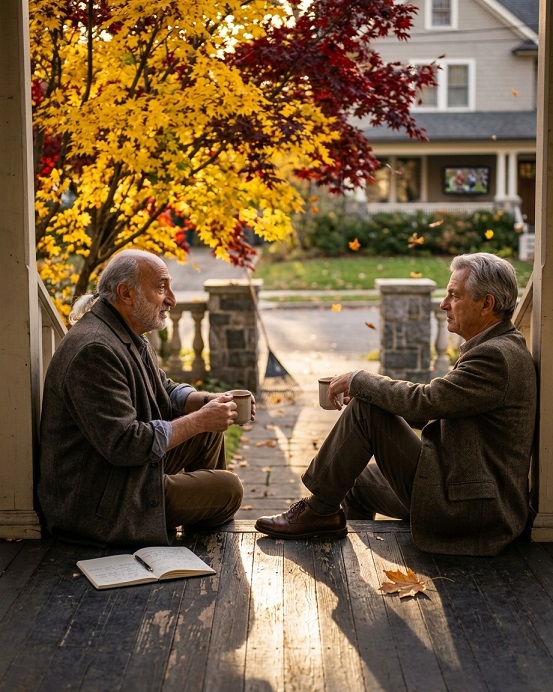
By four o’clock, the sun had reached beneath the porch roof and laid a warm rectangle across the floorboards.
Beyond the steps, a maple had nearly finished turning. Its upper branches still held a little green, though most of the tree had settled into yellow and a red so deep it seemed almost brown in shadow.
Somewhere down the street, a rake scraped against a driveway. Through an open window came the muffled excitement of a football game neither of us was following.
Markham sat with his coffee between his hands.
I had brought a notebook.
“You’ve been looking at that page for some time,” he said.
“I’m deciding what to do next.”
“Have you decided?”
“Yes. Several times.”
He waited.
“The decisions don’t seem to survive the arrival of the next one.”
A leaf came to rest beside his shoe.
“What are the possibilities?”
“Write something. Finish something. Find a way to sell something I’ve already finished.” I closed the notebook. “Apparently I’ve become a small publishing concern with an unreliable employee.”
“Who does the hiring?”
“An optimist. The accounting is handled by someone much less pleasant.”
Markham smiled.
“I’ve been reading about the difference between wanting something and being it,” I said.
“Being what?”
“The person who already has it. The life. The freedom. The security. You stop living as someone waiting for those things and begin living from the sense that they’re already yours.”
“And how has that gone?”
“For several minutes this morning, beautifully. Then I checked my bank account.”
The rake stopped. In the sudden quiet, I heard a squirrel working at something in the gutter.
“I don’t want you to tell me money doesn’t matter,” I said.
“I wasn’t going to.”
“Or that I already possess all the abundance I need because the tree is generous with its leaves.”
He glanced at the maple.
“I doubt the tree would extend you credit.”
“Good. We understand each other.”
He took a sip of coffee.
“What happened during those several minutes?”
“I felt different.”
“In what way?”
“Less pursued. As though I didn’t have to get somewhere before I could enjoy being here.”
“And then you looked at the account.”
“Yes.”
“Did the account contain less than it had ten minutes earlier?”
“No.”
“But you felt pursued again.”
“There were reasons.”
“Certainly.”
I looked at him.
“You’re being unusually agreeable.”
“I’m trying to find out what happened. You keep preparing for an argument.”
“That may be something else I do before I can enjoy being here.”
He laughed, and I found myself laughing with him.
A breeze moved through the maple. Three leaves let go together, separated in the air, and arrived in quite different places.
“I can understand how feeling secure might change my decisions,” I said. “But some of what I read goes further. It says the world begins rearranging itself to match what you’re being.”
“Does it?”
“I don’t know. Sometimes things happen that make the idea very persuasive.”
“Then those things are worth looking at.”
“And the rest?”
“So is the rest.”
I opened the notebook again.
“You don’t think there’s something to it?”
“I think you described several minutes in which you could enjoy your life. I’d be reluctant to hurry past them on the way to explaining the universe.”
I ran my thumb along the edge of a page.
“There was something real about it.”
“What would make it less real?”
“If it was only a feeling.”
“Only?”
“If nothing changed.”
“You changed.”
“My circumstances didn’t.”
“No.”
We sat for a moment.
“That seems a rather small victory,” I said.
“Perhaps. Did you enjoy it?”
“Very much.”
“Then let it be that size until we know more.”
From inside the house came a roar, followed by a commentator explaining why it had been justified.
“I suppose I want the feeling to be a promise,” I said.
“Of what?”
“That things will work out.”
Markham turned his cup slowly in his hands.
“I understand.”
“And you can’t give me that.”
“No.”
He said it without ceremony. I was grateful he didn’t immediately offer me something grander in its place.
“I worry about allowing,” I said eventually.
“What worries you?”
“That it can become a lovely word for avoiding something.”
“What are you avoiding?”
“There you go.”
“You brought it up.”
“I did.”
I looked down at the notebook. Near the top of the page, beneath three crossed-out plans, was the name of someone I had been meaning to contact.
“There’s a letter,” I said.
“An unpleasant one?”
“No. That may be why I haven’t written it.”
He looked puzzled.
“It matters to me. I want it to be good. I want it to open a door.”
“What do you want to say?”
“That I’ve been working on something I think she might find interesting.”
“Have you?”
“Yes.”
“And might she?”
“I believe so.”
He settled back into his chair.
“You make it sound ridiculously easy.”
“The first sentence sounds manageable.”
“It isn’t the first sentence I’m concerned about.”
“No?”
“It’s everything that comes after I send it. Whether she replies. Whether she likes the work. Whether anything comes of it.”
The squirrel emerged onto the gutter, reconsidered us, and disappeared again.
“You’ve given this woman quite a lot to do,” Markham said.
“I haven’t even written to her.”
“Already she must open a door, approve the work, and improve your future.”
“When you put it that way.”
“What if she simply reads a letter?”
I watched the light move along the porch rail.
“I could bear that.”
“Would you still want to send it?”
“Yes.”
“Then perhaps there’s a letter you can write this afternoon.”
I set the notebook on my knee.
“But wanting is supposed to be the problem.”
“According to whom?”
“According to the idea we’re discussing. Wanting keeps you aware of what you haven’t got.”
“Sometimes it does.”
“And that can become miserable.”
“Yes.”
“But you don’t think I should stop wanting.”
“Would you like more coffee?”
“Yes.”
He lifted the pot.
“That seemed harmless enough.”
I held out my cup.
“You’ve reduced a spiritual dilemma to refreshments.”
“I’m seeing how widely the dilemma applies.”
The coffee had been standing too long. We drank it anyway.
“I wanted to write before I knew whether anyone would read me,” I said.
“Do you remember what that felt like?”
“Exciting. Private. Occasionally magnificent.”
“And now?”
“Sometimes all of those things. Sometimes I find myself wondering whether the magnificent bit will pay for groceries.”
“A reasonable question.”
“It changes the writing.”
“How?”
“I start watching it while I’m doing it. Assessing it. Wondering where it belongs and who might want it.”
“Is that useful?”
“Later. During the writing, it can be like having a prospective buyer walk through a house while the occupants are still getting dressed.”
Markham put down his cup.
“Could the buyer come back later?”
“I could arrange visiting hours.”
“You are, after all, the publishing concern.”
“And its unreliable employee.”
“Who seems to have worked through much of Sunday.”
I looked at him, then at the notebook.
“That’s true.”
The rake began again. Its owner had reached the edge of the driveway, where a small heap of leaves waited beside an open bag.
“What would you do,” Markham asked, “if you felt secure enough this afternoon?”
“Write the letter, probably. Take a walk before the light goes.”
“Anything else?”
“Read. Make something good for supper.”
“Would you still work?”
“Yes. I like the work.”
“Then you haven’t been hoping to escape all action.”
“No. Just the feeling that every action is an audition.”
The words surprised me. I wrote them down.
Markham watched a leaf turn slowly on its stem.
“And who is conducting the audition?”
“I was hoping you wouldn’t ask that.”
“We can leave it.”
“No.” I tapped the pen against the paper. “No, I think I know.”
He waited, but I didn’t feel obliged to explain.
After a while, I said, “The practical difficulty remains. Some things need to change.”
“They do.”
“And I’ll have to do things I’d rather not do.”
“Probably.”
“You’re not making much of a case for enlightenment.”
“Were you considering it?”
“Only if it came with administrative support.”
He laughed.
I turned to a clean page.
The letter began badly. I tried to explain too much, deleted a sentence with a line so forceful it nearly tore the paper, and began again.
Markham poured the remaining coffee into his cup.
“You needn’t stay,” I told him.
“Would you prefer me to go?”
“No.”
“Then I’ll sit.”
For a few minutes there was the scratch of my pen, the distant game, and the occasional dry movement of a leaf across the steps.
I wrote what I had made. I wrote why I thought it might interest her.
When I reached the end, the letter was shorter than I had expected.
“Finished?” Markham asked.
“Ready to type.”
“And then?”
“I’ll send it.”
He nodded.
The sun had slipped below the porch rail. Without its warmth, the air was beginning to feel like October.
“Nothing’s guaranteed,” I said.
“No.”
I closed the notebook.
“Still time for that walk.”
Markham rose and carried the cups inside.
At the foot of the steps, I stopped to fasten my jacket. There was work waiting in the house. Some of it would still be waiting tomorrow.
For once, I knew what I intended to do when I returned.
We went out through the gate while there was light.
Read the original & join the discussion on Substack ↗
Continue the conversation.
What changes when every action no longer has to be an audition?
Email a response to this dialogue ↗Private correspondence. Nothing is published without your permission. How the guestbook works.